
What makes a CSR documentary credible?
A credible documentary connects a claim to observable evidence. Suppose a company supports a skills programme. “We trained 500 people” describes an output. “Participants found more stable work” is an outcome and requires different evidence, such as follow-up records or independently collected accounts. The film should say precisely which of those claims the organisation can support.
The Global Reporting Initiative advises organisations to substantiate reported impacts with evidence and to consider stakeholder perspectives. A film is not a substitute for a formal impact report, but the same discipline makes its narrative stronger. GRI 1: Foundation.
| Story element | Question to answer | Possible evidence |
| Need | What problem existed locally? | Baseline data, community context, partner interviews |
| Activity | What did the initiative actually do? | Programme records, site footage, delivery timeline |
| Output | Who or what did it reach? | Verified counts and operational records |
| Outcome | What changed, and for whom? | Follow-up data, participant accounts, independent observations |
| Limit | What remains unresolved? | Stakeholder perspectives and stated measurement limits |
Use the table to distinguish evidence types during research. Do not present an individual testimonial as proof that every participant had the same result.
How do you find the right story?
Start with the audience. Employees may need to understand how their company works with a local partner. Funders may want to see how an intervention was delivered. Community members may care whether their concerns are heard. One edit rarely serves all three equally well.
Then look for a person, place or decision that makes the initiative understandable. The strongest subject is not necessarily the most dramatic. A teacher explaining how a school adapted a programme may offer more insight than a montage of smiling students.
Ask three questions in early research: What changed in the person’s day-to-day experience? What contribution can be traced to the initiative? What other factors might also explain the change? The third question protects the film from overstating the company’s role.
What should be researched before filming?
- Programme history: objectives, location, dates, implementing partners and changes to the original plan.
- Evidence: source and definition of each statistic, reporting period and who verified it.
- People: potential contributors, their relationship to the initiative, preferred language and any risks of appearing on camera.
- Access: filming permissions, travel, site schedules, weather and operational restrictions.
- Use: where the film and its shorter versions will appear, for how long and to which audiences.
A useful original insight for the creative brief is an “evidence-to-scene map”: pair each major claim with the record that supports it, the person who can explain it, and footage that helps viewers understand it. If a claim has no reliable source, revise the claim before writing the narration.
How do you interview people without turning them into a marketing device?
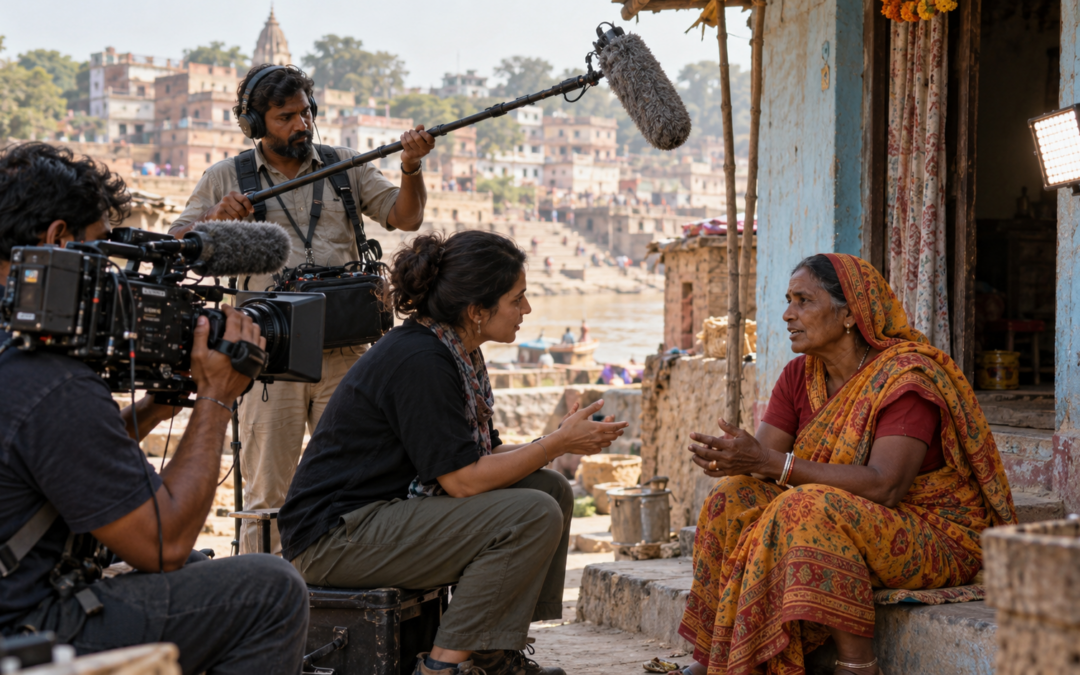
Tell contributors why the film is being made, where it may appear and that participation is voluntary. Give them room to describe their own experience rather than repeating a line prepared by the organisation. Interview local partners as people with knowledge and responsibility, not merely as validators of a corporate claim.
Pay particular attention when filming children or people in vulnerable situations. UNICEF’s ethical reporting guidance stresses informed consent, dignity and the possible implications of a person’s visual setting. Obtain the appropriate permissions and assess whether identifying someone could expose them to harm. UNICEF ethical reporting guidelines.
Consent should also inform the edit. A technically valid release does not justify removing context from an answer or placing footage beside a claim it does not support. When a story is sensitive, agree on an internal review process for factual accuracy and safeguarding before publication.
What production process works for a CSR documentary?
1. Define the purpose and audience
Write a one-sentence brief: “This film will help [audience] understand [specific change] and [next action].” Decide whether the main film is for a website, an annual report launch, a stakeholder event or field outreach. That choice shapes its length and pace.
2. Research and test the story
Review programme material and speak to the implementing team and potential contributors. Identify the central question, the evidence available and the gaps. Do not lock the ending before the research is complete.
3. Plan the shoot and permissions
Prepare interview themes, locations, a realistic schedule, consent arrangements and a shot list. Capture the work in its actual setting. When footage must be recreated or illustrative, label it appropriately rather than letting viewers assume it documents an observed event.
4. Edit for meaning and accuracy
Build the film around a clear sequence: context, action, lived experience, evidence and what comes next. Check names, numbers, translations and subtitles. Avoid music or editing choices that push a participant’s words toward an emotion they did not express.
5. Deliver versions for their real uses
A main film may support a presentation or website, while shorter cuts can answer one question each on social channels. Budget for captions, accessible text and language versions where the audience requires them. Superfly’s vertical content services page is relevant when the brief includes mobile-first cutdowns.
How much does a CSR documentary cost, and how long does it take?
There is no useful fixed price without a defined brief. Costs and timing depend on research, the number and distance of locations, shoot days, permissions, crew, translation, archive material, animation, review rounds and the number of final versions. A one-location interview film and a multi-state documentary have different production requirements.
Ask a documentary production house in Delhi for a proposal that separates discovery, filming, editing and deliverables. Confirm which stakeholders must approve facts and safeguarding, and build that review time into the schedule. A quote that only lists shoot days may leave the most important story work undefined.
How should you judge whether the film worked?
Choose measures that match the intended audience. For an internal film, ask whether employees understood the initiative and the partner’s role. For stakeholder outreach, track qualified conversations or requests for programme details. For digital distribution, combine viewing behaviour with the quality of follow-up enquiries.
The film’s production quality is one part of the result. Check whether viewers can accurately explain the initiative after watching, whether partners feel fairly represented and whether every impact claim remains defensible. Views alone cannot answer those questions.
What mistakes weaken trust?
- Opening with the company’s achievements before explaining the local need.
- Calling activities or participant counts “impact” without evidence of an outcome.
- Using staged scenes without making their illustrative nature clear.
- Reducing participants to emotional sound bites while omitting their expertise and agency.
- Making the company the sole hero when community members and local partners did much of the work.
- Treating consent as a formality and overlooking future uses of the footage.
A CSR film can still show the organisation’s role. The difference is specificity: explain what it funded, built or supported, alongside what partners and participants contributed.
What should be in your brief to documentary makers in Delhi?
Share the programme objective, intended audience, locations, existing evidence, potential contributors, distribution channels, languages, approximate budget and decision makers. State any safeguarding requirements and claims that need independent verification. Ask the team how it would research the story before it proposes a final script.
Superfly’s documentary production work shows relevant films, while its corporate video production page is useful if you are deciding whether your objective calls for a documentary or a more organisation-led format. The article on choosing a corporate video production partner also covers broader procurement questions.