
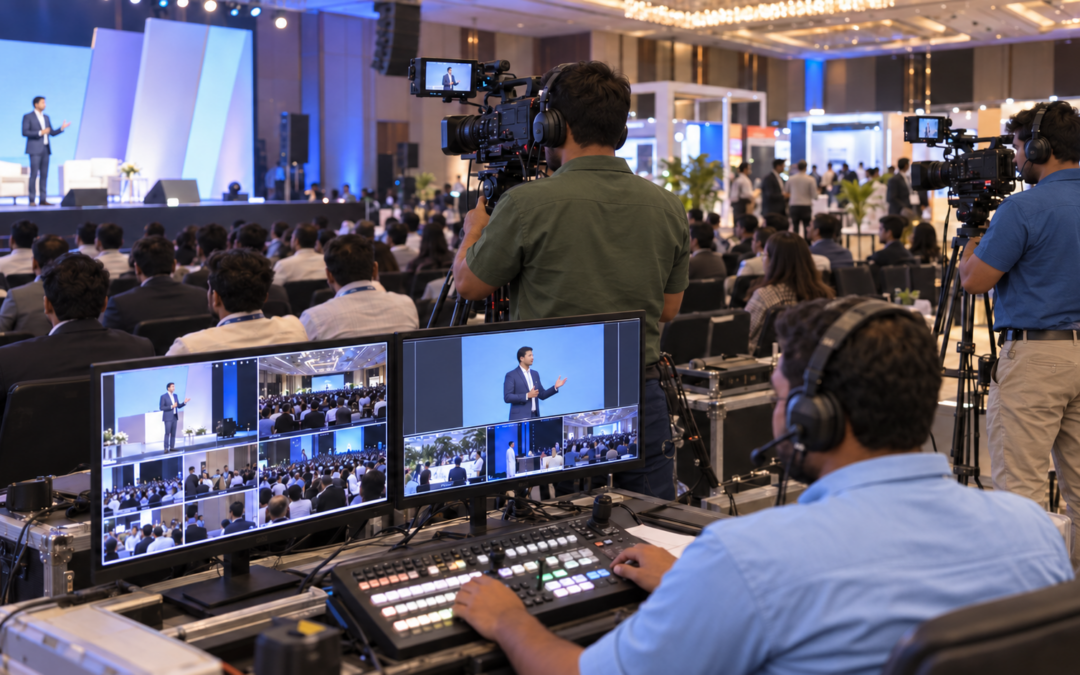
Plan the videos you want to publish after the event before you book the crew. Give each deliverable an audience, a purpose and a capture requirement, then protect the sound, permissions and recordings needed to make it usable. This turns event coverage into a planned source of content rather than a folder of footage waiting for someone to edit it.
A conference may contain useful customer questions, expert explanations and product demonstrations that never appear in a highlights film. The planning task is to identify those moments and give the production team time and access to capture them properly.
In this article
- Decide what the footage must achieve
- Choose live broadcasting, recording or highlights
- Plan conference and exhibition coverage
- Brief the crew and protect the recordings
- Organise edits, publishing and measurement
- Compare costs and choose a production partner
Key takeaways
- Start with the intended content, not only the event schedule.
- A live stream, a session recording and a promotional edit need different coverage decisions.
- Clear interview sound, complete demonstrations and participant permissions determine what you can reuse.
- Give every deliverable an owner, approval route and publishing date.
The problem opportunity and promise
Problem: Organisers often commission cameras for the event day, then discover that the recordings lack the clean audio, context or rights needed for later content.
Opportunity: One planned production can support remote attendance, sales follow-up, internal learning and promotion of the next event. These uses need to be included in the brief rather than added after the shoot.
Promise: The process below helps you commission event coverage with a clear plan for what happens once attendees leave.
Executive summary: Choose the audience and deliverables first. Map them to the agenda, assign capture responsibilities, test the broadcast setup where required, and agree on editing, file delivery and publication before the event begins.
What does event coverage beyond the event day mean
It means capturing an event for specific later uses as well as documenting what happened. The output might include complete sessions, short expert answers, customer interviews, product demonstrations, approved photographs and a highlights film.
The useful question is not how many clips a shoot can produce. It is which clips answer a real audience need. An exhibition visitor asking about installation may provide the starting point for a helpful product video; a montage of the stand cannot answer the same question.
Superfly’s event coverage and broadcast service is the relevant starting point when your brief combines recording, live delivery and edited content.
Which content should you plan before the event
Create a small deliverable map. For each asset, write who will watch, what they should learn or do, what footage is necessary and who will publish it. This gives the crew a purpose for each camera position and interview slot.
| Intended asset | Audience and purpose | Capture requirement |
| Full session recording | People who missed a talk or need to revisit it | Continuous coverage, clear speech and readable presentation material |
| Expert answer clip | Prospects evaluating a question | A complete answer, speaker identification and relevant context |
| Product demonstration | Buyers comparing functionality | The entire demonstration, close-ups and intelligible explanation |
| Customer interview | Prospects seeking evidence | Permission, specific questions and a quieter recording area |
| Highlights film | Future attendees and stakeholders | Event atmosphere, key moments and a coherent story |
| Sponsor package | Partners reviewing their participation | Agreed visibility, activities and approved deliverables |
For example, a hypothetical technology exhibition might prioritise three product demonstrations and two customer interviews alongside its recap. Those are planning targets, not guaranteed results: the schedule and participant availability must support them.
Do you need live broadcasting or only recorded coverage
Choose live event broadcasting services when a remote audience needs to experience the event as it happens. Choose recording when the value is in access afterwards. Choose highlights when the main purpose is to communicate the event’s story in a shorter edit.
| Approach | Useful when | Planning implication |
| Live broadcast | Remote viewers need timely access | Tested connectivity, platform access, live audio, switching and contingency planning |
| Full recording | Sessions will become an archive or learning resource | Continuous recording, presentation capture and organised files |
| Highlights coverage | The event needs a concise promotional story | Selective moments, interviews and visual variety |
| Combined production | Live access and later content both matter | Separate responsibilities and a shared recording and delivery plan |
Live broadcasting solutions do not automatically include every file required for later editing. Ask whether the team records only the switched programme feed or also individual camera and audio sources where necessary. A local recording can preserve content even when a platform or connection fails.
YouTube explicitly recommends a local archive as a backup in its live-stream archiving guidance. Treat that as one part of a wider plan, alongside tested power, connectivity and operator responsibilities.
How should conference and exhibition coverage differ
For a conference, prioritise complete ideas. Coordinate with the sound team, identify important sessions and capture presentation material directly where possible. Plan how the edit will identify speakers and make slides understandable to viewers who were not in the room.
For event and exhibition coverage in Delhi NCR, the challenge often includes simultaneous activity: stage talks, stand demonstrations, visitor interactions and interviews. Give the crew a priority order so filming one busy area does not mean missing the most useful scheduled demonstration.
Venue access also matters. Confirm rigging and filming permissions, loading and setup windows, stage sightlines, sound feeds and interview space with the organiser and venue. Ask about these conditions rather than assuming every hall or exhibition stand offers the same setup.
If your later content supports company communications, connect the brief to the intended corporate video content. If it will tell an extended story about a programme or community, a separate documentary production approach may be more appropriate than trying to build that story from incidental event footage.
What should you put in the production brief
- Event type, venue, date, agenda and expected access restrictions
- Main audiences, communication goals and publishing channels
- Priority sessions, demonstrations, contributors and sponsor commitments
- Live platform, access permissions and remote audience requirements
- Required recordings, edit lengths, aspect ratios, languages and captions
- Interview questions, participant permissions and content restrictions
- Crew responsibilities, technical rehearsal and contingency arrangements
- Budget range, approval owners, delivery milestones and file retention terms
The most useful distinction is between essential and optional coverage. Label the keynote recording as essential if it is a contractual deliverable; label general atmosphere footage as secondary when time is limited. A vague instruction to capture everything creates competing priorities.
For a broader explanation of planning, filming and post-production, see Superfly’s article on what video production involves.
How do you protect the footage you will need later
Capture sound that can stand on its own
A beautiful clip with indistinct speech is difficult to turn into an expert answer or sales asset. Agree on the sound feed for the stage, separate recording where appropriate, and a quieter place for interviews. Check a sample recording with headphones before the programme starts.
Record complete thoughts and demonstrations
Ask interviewees to give answers that make sense without the question being heard. For demonstrations, capture the setup, the action and the explanation rather than isolated close-ups. The edit needs enough context to avoid presenting a misleading fragment.
Plan formats before capture
Do not assume that a wide shot containing a panel will crop well into a vertical clip. Decide which scenes need separate framing and where graphics can sit. Superfly’s vertical content services are relevant when social cutdowns are a planned deliverable.
Agree on permission and intended reuse
Confirm arrangements with speakers, interviewees, sponsors and the organiser before recording. Discuss whether material may appear in organic posts, paid advertising, internal resources or future promotion. Also clarify rights for music, presentation material and any third-party footage.
Name and back up files deliberately
Agree on what the handover contains: final edits, session masters, selected photographs and any contracted source files. Use consistent session names and dates, keep a second copy, and confirm retention periods. An organised archive reduces the work required when a new edit is requested later.
What should be tested for live broadcast services in Delhi
Test the whole viewing chain at the venue: camera and presentation sources, audio, encoder, connection, platform and playback on a separate device. A working camera feed is not proof that the remote audience receives good sound or readable slides.
YouTube’s live-streaming checklist includes testing backup arrangements and checking the local archive. Use the chosen platform’s current guidance, then assign who will respond if an input, encoder or network connection fails.
Keep requirements understandable in the brief. Instead of requesting the highest possible resolution without context, explain the viewing experience, audience size assumptions and interaction needs. The provider can then propose a suitable technical plan.
How do you turn the recordings into a publishing plan
Use three editing priorities. First, publish time-sensitive material such as a thank-you recap or approved announcement. Next, release useful content such as speaker answers and demonstrations. Finally, prepare lasting assets for sales, training or promotion of the next edition.
Vimeo’s event content repurposing article describes ways marketers have reused event material, including recaps and articles. The practical lesson is to give the content a destination and owner before it is captured.
| Publishing stage | Possible deliverables | Approval focus |
| Immediate follow-up | Recap, photographs and announcement clips | Names, facts, permissions and timely relevance |
| Ongoing communication | Expert answers, demos and session extracts | Context, clarity and audience usefulness |
| Longer-term reuse | Sales resources, learning library and next-event promotion | Currency of claims, rights and brand suitability |
Build this into the social media publishing plan, rather than handing over an unprioritised set of clips. If an approved edit will become advertising, commission it with the appropriate rights and purpose through the commercial production brief.
What is the difference between filming and media coverage
Filming produces your own visual assets. Editorial media coverage means an outlet chooses to report on the event. Hiring media coverage services in New Delhi does not, by itself, guarantee independent press attention.
If earned coverage is a goal, coordinate filming with the communications team: prepare verified announcements, press-ready photographs, captions and approved spokespeople. Superfly’s public relations service is relevant to that separate outreach task.
How much should you budget and how do you assess value
Costs depend on venue access, event duration, simultaneous stages, crew, sound, live infrastructure, travel, editing, versions and delivery speed. A quote for a roaming camera and highlights film is not comparable with a quote for a multi-camera live production and a complete session archive.
Ask for the capture, live delivery and editing scope to be clear. If the budget is limited, prioritise the sessions and assets with a defined use. Recording selected sessions properly may be more useful than collecting incomplete footage of every activity.
Assess value against the goal: useful follow-up conversations, consumption of learning content, sponsor deliverables fulfilled or future-event enquiries. Keep video engagement and business results separate, and avoid attributing all campaign performance to the film alone.
How do you choose a professional event coverage company in Delhi
Ask for a relevant sample and an explanation of how it was produced. The team should be able to describe its approach to sound, simultaneous activities, live contingencies, edit approvals and file handover. Confirm who makes decisions on site when the agenda changes.
Searches for the “best event coverage and broadcast solutions” or the “best broadcasting solution provider” are useful starting points, but those labels do not establish suitability. Compare providers against your venue, audience and deliverables, then review the scope in writing.
Superfly’s event and broadcast portfolio includes BBC Work Life India in Varanasi. Use portfolio samples to assess the relevant filming and broadcast style; a listed project alone does not establish the results of a campaign.
Frequently asked questions
When should planning begin
Begin while the agenda, venue access and deliverables can still change. The production team needs time to review the location, coordinate audio and schedule contributors, not only arrive with cameras.
Can a live stream be edited into highlights
Yes, but editing flexibility depends on the sources recorded. Agree in advance on local recordings, individual feeds where needed, and additional atmosphere or interview footage.
Do we need to broadcast every session
No. Prioritise sessions that serve the remote audience. Other material may work better as a recording or a shorter edited summary.
How many clips should one event produce
There is no useful fixed number. Set targets from the agenda and publishing plan, then choose clips for their relevance and quality rather than volume.
Can the footage be reused in paid ads
Potentially, if the permissions and licences cover that use. Confirm speaker, talent, music and third-party rights before commissioning the paid version.
What should the final handover include
The contracted edits, recordings, formats and supporting files, with clear filenames and storage arrangements. Specify source-file access, retention and future edit terms before booking.
Plan the next use before the first shot
Event coverage in Delhi NCR works beyond the day when the capture plan reflects what your audience will need afterwards. Choose the useful stories, protect the recordings and assign a publishing owner to each deliverable.
Share your agenda, venue details and intended content with Superfly’s team to discuss the coverage and broadcast approach that fits those priorities.