
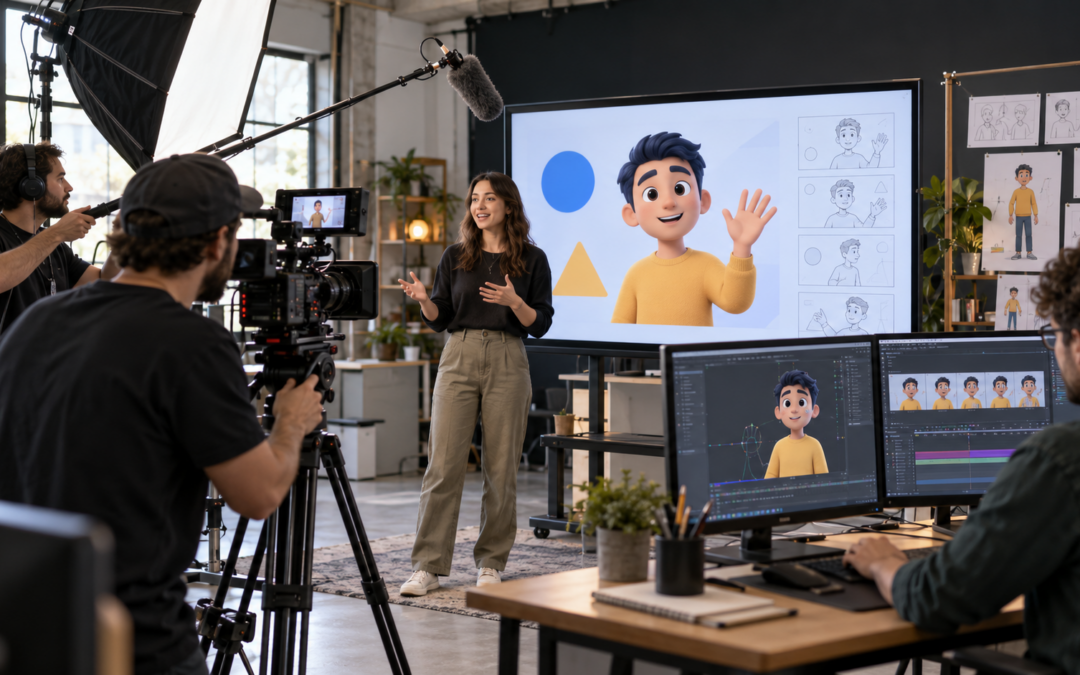
Choose 2D animation when your main job is to explain an idea clearly. Choose 3D when viewers need to see an object, space or mechanism from multiple angles. Neither format is automatically better for a brand. The right choice depends on what your audience must understand, how the video will be used and what your production budget needs to cover. A software company explaining a workflow may need clean diagrams and a strong script. A manufacturer showing how a machine operates may need depth, realistic movement and views a camera cannot easily capture. Choosing the visual style before defining the communication goal can make either project less effective.
What is the difference between 2D and 3D animation?
2D animation creates movement in a flat visual space. It may use illustrated characters, icons, typography, diagrams or layered artwork. 3D animation uses models built in a space with depth, allowing the team to control camera angles, lighting and movement around an object.
That technical distinction matters less to a buyer than the viewing experience. A 2D diagram can remove unnecessary detail so someone understands a process in seconds. A 3D model can supply the detail needed to judge how a physical product looks or works.
Comparison at a glance: 2D is strongest for ideas, steps, data and interfaces; 3D is strongest for objects, spaces, components and movement. 2D tends to be graphic or illustrated; 3D can be stylised or realistic. Both can be tailored to a brand’s identity.
These are planning tendencies, not fixed rules. A detailed frame by frame 2D film can take substantial work, while a simple 3D treatment may be relatively contained. Ask for a quote against a defined script and visual treatment rather than assuming one format always costs less.
When does 2D animation work better?
Choose 2D when the audience needs to understand a concept rather than inspect a physical object. A B2B software brand could use illustrated screens, labels and transitions to explain how a request moves through its platform. A financial services team could show a customer journey without depicting every office, employee and device realistically.
2D may be a good starting point for software and app explainers; service processes and customer journeys; internal training and onboarding; campaigns built around a distinctive illustration style; and videos that must adapt to several languages or audiences.
The main risk is oversimplification. If a buyer needs to judge a product’s construction, finish or physical operation, flat illustrations may leave important questions unanswered. For further context on styles, read Superfly’s article on the difference between motion graphics and animation.
When does 3D animation work better?
Choose 3D when depth is part of the explanation. Imagine a buyer evaluating a warehouse automation system. A 3D sequence could show how equipment moves through a space, where components sit and what happens during a task. For a consumer product, it could show features from angles that would be difficult to capture consistently on camera.
3D is useful for product visualisation before a physical shoot is possible; machinery and component demonstrations; architecture and spatial walkthroughs; processes inside an object that a camera cannot show; and reusable product models for several videos or campaigns.
The main risk is spending heavily on visual realism that the message does not require. A polished model cannot rescue a script that fails to explain why a feature matters to the customer. Superfly’s animation and explainer video production page offers examples of different animation treatments.
How do you decide between 2D and 3D?
1. What must the viewer understand?
Write one sentence: “After watching, the viewer should understand—–.” If the blank describes a workflow, service or idea, start by exploring 2D. If it describes the shape, position or movement of a physical object, explore 3D.
2. What evidence does the buyer need?
An explainer should answer the buyer’s real question. A procurement team may need to see how equipment operates. A marketing manager evaluating software may need a clear view of the user journey. Those are different visual problems.
3. Where will the video appear?
A short social cut, a website explainer, a sales presentation and an exhibition screen place different demands on detail, pacing and text size. Decide the main viewing environment early, then specify any additional formats in the brief. If social feeds are central, consider the formats discussed on Superfly’s vertical content page.
4. What will change after launch?
If the video contains product screens, pricing or process steps that may change, discuss updates before production begins. Ask which assets can be edited separately and what a future revision would involve. Do not assume that either 2D or 3D is automatically easy to update.
5. What can the budget support across the whole video?
The budget must cover more than animation. Scriptwriting, storyboards, design, voiceover, sound, revisions and versions for different channels all affect the scope. Compare complete proposals against the same deliverables.
A useful test: Ask a production partner to show how the same 15 seconds of script would work in 2D and 3D. You can then compare clarity, brand fit and production effort against a common message. That is more useful than comparing unrelated showreel clips.
Can one video combine 2D and 3D?
Yes. A hybrid treatment often gives each format a specific job. A product film could use 3D to reveal an internal mechanism, then switch to 2D labels and diagrams to explain the customer benefit. The styles should share a clear visual system so the shift feels intentional.
A hybrid approach is useful when only a small part of the story requires depth. It should be planned at the storyboard stage; adding 3D late in production can affect timing, transitions and budget. If the project also includes filmed footage, review the options on Superfly’s commercial video production page.
What affects the cost of a 2D or 3D animated video?
There is no reliable price based on format alone. Scope depends on script and runtime; visual complexity; the availability of brand files and product models; the amount of movement; versions for different formats or languages; and the review process.
A useful quotation should state what will be delivered and what assumptions the team has made. If two estimates differ considerably, compare their scripts, level of detail, revision terms and output files before comparing their totals.
What should you include in an animation brief?
Audience: Who will watch, and what do they already know? Objective: What should they understand, feel or do next? Core message: What is the one point they should remember? Product details: What must be shown accurately? Brand references: Which visual treatments fit or conflict with your identity? Distribution: Where will the video run? Deliverables: Which lengths, formats, subtitles and language versions do you need? Timeline: Who approves each stage?
If you are comparing an animation video production company in Delhi with an explainer video production house in Delhi, ask both to respond to the same brief. Their reasoning about the format and story will tell you more than a list of software or effects. You can also review Superfly’s animation work and its approach to corporate videos when defining how the film fits a wider brand communications plan.
Frequently asked questions
Is 2D animation always cheaper than 3D?
No. Cost depends on the design, number of scenes, movement, revisions and deliverables. A complex illustrated film may require more work than a limited 3D sequence. Compare quotes for a defined scope.
Is 3D animation better for product videos?
It can be when buyers need to see a product’s form, components or operation. If the product’s main value is a simple benefit or workflow, 2D may communicate it more directly.
Which format is better for an explainer video?
Choose the format that makes the explanation easiest to follow. 2D often suits abstract services and processes; 3D can help when understanding a physical object is essential.
Can 2D animation look premium?
Yes. Art direction, pacing, typography, sound and a clear story shape the final impression. A premium result does not require realistic depth.
Can an existing 3D product model be used in a video?
Potentially. The production team will need to assess its file format, level of detail, textures and suitability for animation. A model created for engineering or product design may still need preparation for video.
How do we judge whether the finished video worked?
Choose measures that match its purpose before launch. For a website explainer, you might examine engagement and relevant enquiries. For a sales video, ask whether prospects understand the product sooner or raise more informed questions. Avoid judging success by views alone.
Choose the format that makes the message clear
The best animation style is the one that helps your audience make sense of what you offer. Start with the buyer’s question, identify what must be visible to answer it, and test the proposed visual treatment against a short section of script.
If you have a product or service to explain, share the brief and the intended viewing channels with Superfly’s team. They can help assess whether 2D, 3D or a combination gives the story the clarity it needs.
Suggested visuals for publication
A side by side image showing the same product or process in 2D and 3D; a short storyboard strip illustrating the “same 15 seconds of script” test; an embedded approved Superfly animation project with a caption explaining the chosen style; and a simple decision graphic based on the five questions above.