
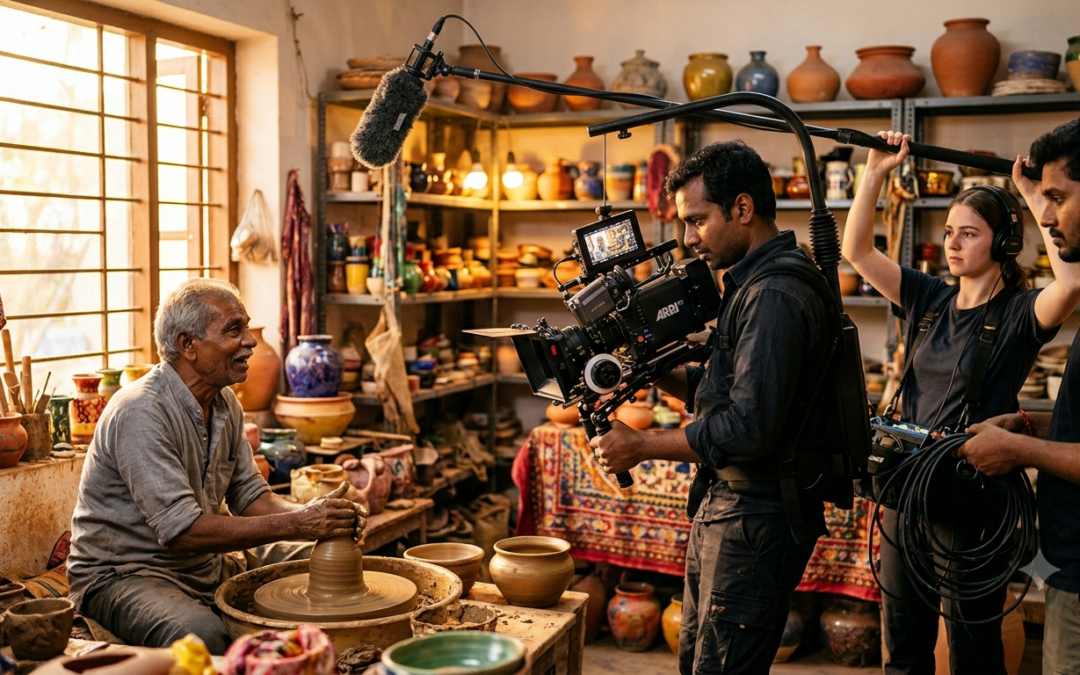
Choose a documentary production company in Delhi that can show you relevant completed films and explain how it would research your programme, protect participants, and manage filming across your locations. Give each shortlisted team the same brief so you can compare what it will deliver, how it will work in the field, and what the full project will cost.
In this guide
- Decide which film to commission
- Shortlist and compare production companies
- Assess consent and safeguarding
- Prepare the brief and compare costs
- Plan production and measure results
- Review a documentary example
- Read the FAQs
Key takeaways
- Watch a complete film and ask what the team handled directly.
- Ask who can pause filming or stop publication if a safeguarding issue arises.
- Compare quotes against the same shoot days, languages, review rounds, and usage rights.
- Choose the main audience and where they will see the film before deciding its length and formats.
Problem. A strong showreel can leave you with little sense of how a crew will conduct sensitive interviews, verify claims, or handle a change in field access.
Opportunity. A documentary can show donors, partners, and communities how a programme works by bringing together participant perspectives, field footage, and evidence your team can substantiate.
Promise. Use the questions and comparison criteria below to turn a shortlist into a decision your programme, communications, and procurement teams can explain.
Executive summary. Agree internally on the audience, release channels, and safeguarding requirements. Invite shortlisted companies to respond to one brief, and resolve any differences in scope and rights before awarding the project.
When should an NGO or foundation commission a documentary?
Documentary film production uses research, interviews, and footage of real people or events to tell a factual story. Commission a documentary when viewers need to understand how a programme works, what changed for participants, or which challenges remain. Start planning when you can identify a credible story, secure field access, and set aside time for review.
Choose the format around the audience’s needs
| Communication goal | Format to consider | What it can show |
| Help a funder understand a programme in practice | Short documentary | Participant perspectives, field activity, and evidence of change |
| Introduce your foundation and its work | Organisational overview film | Your mission, programmes, partners, and geographic reach |
| Explain a service or process when filming would expose identities | Animated explainer | How a service works using approved illustrations and narration |
| Share a conference or programme launch with a wider audience | Event coverage | Key sessions, interviews, and highlights for follow-up |
How do you compare documentary film production companies in Delhi?
Ask each team for a completed project with similar demands, such as interviews in multiple languages, filming in remote locations, or several levels of client approval. Find out who researched the story, directed interviews, arranged field access, and edited the film. If an agency is bidding with a production partner, ask to meet the people who will lead the shoot and edit.
For a programme spread across India, ask how the Delhi team would work with local crews and field partners. Its proposal should name who coordinates access, who interviews in each language, who checks translated quotations, and who makes editorial decisions across locations. A remote production setup can be an option for some shoots when local teams can handle fieldwork and the director can supervise remotely.
What to look for when comparing proposals
| Criterion | Question to ask | What to look for |
| Relevant experience | Can we watch a complete film and speak with a past client? | A finished example and a clear explanation of the team’s role |
| Research and evidence | How will you verify the claims made in the film? | A plan to check interviews, programme records, and on-screen figures |
| Safeguarding | What happens if a participant asks to stop or if an edit exposes their identity? | A named decision-maker, escalation steps, and an agreed response |
| Field logistics | Who handles local languages, permissions, and schedule changes? | Named owners and a plan for changes in access or availability |
| Scope and rights | What can we publish, where, and in which versions? | An itemised quote and clear terms for distribution and reuse |
How should a documentary crew handle consent and safeguarding?
Ask the documentary production house to explain consent in a language participants understand. People should know why they are being filmed, where the material may appear, that participation is voluntary, and whom to contact if they change their mind. Explain any practical limits on withdrawing material once it has been published or shared. For interviewing and filming practice, see WITNESS’s informed consent guide.
Give your safeguarding lead a chance to review the filming plan and relevant cuts before release. A voice, school uniform, building sign, or combination of location clues can identify someone even when their face is blurred. For projects involving children, review UNICEF’s guidance on children’s privacy, permission, and protection from harm alongside your organisation’s safeguarding policy.
Ask how consent will carry over into each edit. A participant may agree to appear in a private donor screening but decline public social media use. Record permitted uses by participant and version, and brief the editor on those limits before creating shorter cuts. Agree who can access raw footage, where it is stored, and when it will be deleted or handed over.
What should your brief include, and how do you compare costs?
Send every team the same brief. Include the programme and intended audience, what viewers should understand or do, the proposed shoot locations and interview languages, known access restrictions, your budget range, and the planned release date. Identify who will review facts and translations, who will check safeguarding, and who will approve the final cut.
Ask for an itemised quote covering research and pre-interviews, filming days, crew travel, local support, editing, translations, captions, and any music or archive licences. Specify how many review rounds, language versions, and shorter edits you need. Ask what triggers extra charges, such as another site visit or a reshoot, and whether the proposal includes applicable taxes.
For example, one bid may cover a two-location film and English captions, while another includes regional-language subtitles and three social edits. Request a revised quote against the same deliverables before comparing totals. For additional cost categories, see Superfly’s guide to hiring a film production house in Delhi.
What happens after you hire a documentary production partner?
- Research and plan. Agree on the story question, interviewees, supporting records, locations, safeguarding plan, and delivery schedule.
- Film in the field. Confirm access and consent, record interviews, and capture everyday activities that help viewers understand the programme.
- Review the edit. Check factual claims, translations, and identifying details. Have one project lead consolidate feedback so the editor can work from a single set of notes.
- Deliver and distribute. Approve the main film and any captions, transcripts, or short edits. Match each version to its intended use, such as a donor screening, website, or YouTube.
- Measure the response. Choose a measure that fits the goal, such as follow-up conversations after a funder screening or clicks through to programme resources after an online release.
Ask your programme team to distinguish outputs from outcomes in the edit. For example, the number of people attending a training session shows reach. A claim about sustained employment requires follow-up evidence. See Superfly’s guide on making a credible CSR documentary for more on checking those claims.
What can NGO teams learn from BBC Media Action’s Kilkari films?
Challenge. Explain a service that delivers timely maternal and child health information through recorded phone calls. The GSMA overview of Kilkari explains how families receive messages relevant to pregnancy, childbirth, and childcare.
Strategy and execution. The published films frame Kilkari around specific uses, including antenatal information in remote regions and health information for new mothers. Both appear in Superfly’s documentary production portfolio.
Published output and lesson. The portfolio includes separate films on those two uses. For your brief, define which part of the programme viewers should understand and whose perspective can explain it. Use programme evidence to substantiate any impact claim about the intervention.
Frequently asked questions
What is the best documentary production company in Delhi for an NGO?
The best fit is the team with relevant finished work, a credible safeguarding process, and a clear plan for your field locations and languages. Ask to meet the producer or director who will be accountable for delivery.
Can a Delhi-based team film at NGO programme sites across India?
Yes. Ask whether the same director will oversee each site, when local crew will join, and who will confirm access and coordinate interpreters. Have the company itemise travel and local production costs.
How long does an NGO documentary take to produce?
The schedule depends on research, field access, travel, translation, and review. If you have a fixed screening date, work backwards from it and ask the team to include time for factual checks, safeguarding review, and final approvals.
Can we use the documentary for fundraising and social media?
Plan each use in the brief and confirm that participant permissions and third-party licences cover it. If you need screening, web, and social versions, budget for the extra edits and approve each one before release. Superfly’s guide to planning video deliverables before a shoot offers a related approach.
Who owns the final documentary and raw footage?
Ask the production company to set out ownership and usage terms for the finished film, source footage, and edit files. Confirm which materials will be handed over and whether licences for music or archive footage limit how you can reuse them.
Take the next step with a one-page brief
Write down the story you want to tell, who needs to see it, where you need to film, and what you must deliver. Share the same brief with your shortlisted teams and use their responses to assess how each would tell the story and protect the people in it.
Superfly Productions is based in Delhi and works across India. If you’re planning a film for an NGO or foundation, share your documentary brief with Superfly to discuss the scope, fieldwork, and delivery options.