
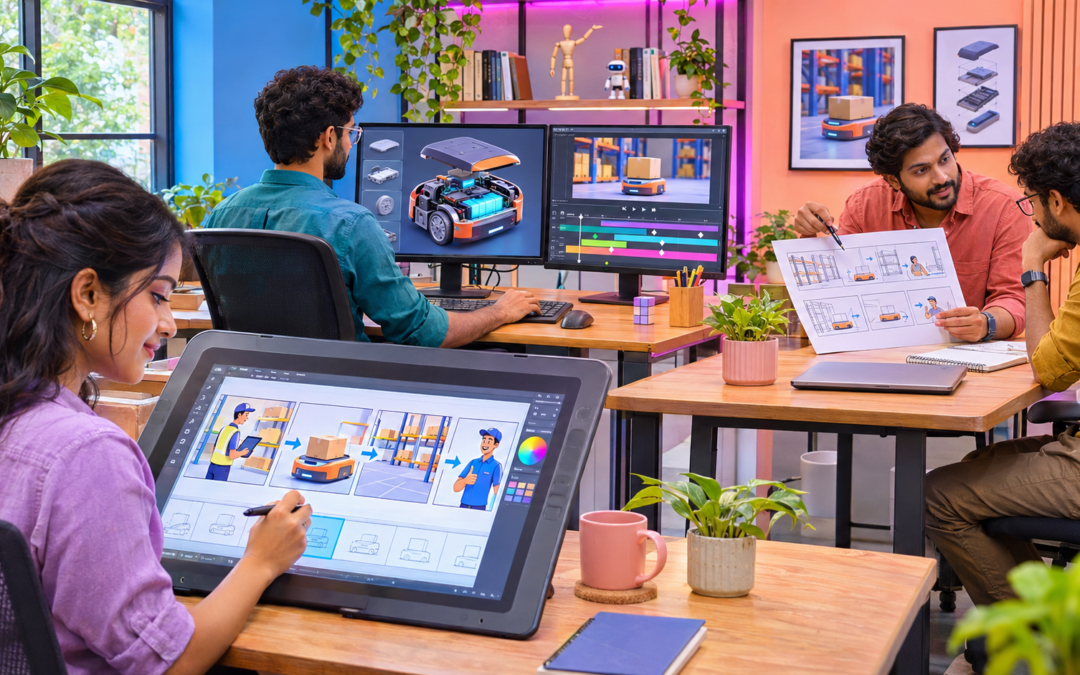
Yes – an explainer video can make a complex product easier to understand, helping buyers decide whether it deserves a closer look. It works best when it resolves a specific question through a clear story and accurate visuals. It supports the sales process; it cannot replace product fit, credible evidence or a useful conversation with the customer.
A product may have valuable capabilities yet be difficult to explain in a first meeting. Technical terminology, unfamiliar workflows and several stakeholder priorities can leave prospects unsure what the product actually does for them.
Before approaching an explainer video production company in Delhi, identify where that uncertainty occurs. The most useful brief describes what the buyer needs to understand next, rather than asking the team to animate a long feature list.
What is an explainer video meant to do?
An explainer video shows what a product or service does, how it addresses a problem and why that matters to a defined audience. It may use animation, filmed demonstrations, screen recordings, interviews or a combination.
Animation is a visual technique; explanation is the communication task. A film can be animated without explaining anything clearly, while a simple recorded demonstration can answer a buyer’s question very effectively.
For a broader view of planning and delivery, this introduction to the video production process explains the main stages.
When can an explainer help a complex sale?
Buyers struggle to describe the product after a meeting
Ask prospects to explain the product’s role in their own words. If they repeat feature names without connecting them to a useful task, the explanation may need attention.
A focused video can establish a common starting point before a demonstration or follow-up discussion. It should help the buyer understand what is relevant to their situation, including where further questions remain.
The important process is difficult to see
Data moving between systems, an internal mechanism or a sequence across several locations may be hard to capture directly. Animation can make selected relationships visible and control the order in which information appears.
An animated video production company should explain what its visual approach clarifies. Motion, depth and effects are useful when they help the viewer follow the product’s operation.
Several stakeholders need a shared introduction
A buyer may need to explain the product to colleagues who did not attend the initial discussion. An approved overview can give those colleagues consistent information.
However, a technical reviewer and a finance decision maker may need different supporting detail. Use the overview as a shared introduction, then provide relevant demonstrations or documents for their separate questions.
When will an explainer not solve the problem?
An explainer is unlikely to resolve an unattractive offer, weak product fit or unanswered concerns about implementation. If buyers already understand the product and hesitate over integration, support or commercial terms, another overview may add little.
Identify the obstacle before selecting the content:
| Buyer’s question | Useful content to consider | What it should establish |
| What does this product do? | Focused explainer | The problem, product role and intended user |
| How does the task work? | Product demonstration | A real workflow and the steps involved |
| Will it fit our requirements? | Technical walkthrough and discussion | Relevant conditions, dependencies and limitations |
| Has it worked for a relevant customer? | Approved customer story | A documented experience and supported outcomes |
| How would the team use it? | Training or onboarding content | Specific actions and responsibilities |
A company introduction is a different assignment again. If the immediate need is to establish the organisation’s capabilities, corporate video production may be the appropriate starting point.
Should you choose animation or a filmed demonstration?
Use the format that makes the required information easiest to judge. Animation is useful for abstraction and hidden processes; recorded footage is useful when buyers need to see actual operation.
| Format | Useful for | What to watch for |
| 2D animation and diagrams | Workflows, services and relationships | Simplification that hides an important condition |
| 3D animation | Physical form, components and spatial movement | Detail or realism that adds little to the explanation |
| Screen recording | Software tasks and user journeys | Small text, confidential data and changing interfaces |
| Live-action demonstration | Product handling and real operation | Filming that obscures essential actions |
| Hybrid video | Combining product evidence with labels or diagrams | Visual transitions that interrupt understanding |
The distinction is explored further in 2D versus 3D animation for brands and this guide to motion graphics and animation.
How do you simplify the message without distorting it?
Simplify the route through the information, rather than removing facts the buyer needs to make a sound decision.
Start with a familiar task. Show where the difficulty occurs, what the product changes and what the viewer needs to know about that change. Introduce technical terms only when they help explain the sequence.
A useful planning distinction is between product complexity and decision complexity. A product may have many components, but the first buying decision may depend on understanding only one workflow. Explain that workflow clearly, then offer access to the deeper detail.
Do not imply that every implementation is identical. Where the result depends on configuration, compatible systems or specific operating conditions, make the relevant qualification understandable.
What should the script include?
Build the script around one communication objective. A practical sequence is:
- Identify the intended user and the situation they recognise.
- Establish the specific problem or friction.
- Introduce the product’s role in addressing it.
- Show the important actions or relationships.
- Connect those actions to a supported benefit.
- Offer the appropriate next step, such as a demonstration or requirements discussion.
Before writing scenes, ask the sales team which explanations they repeat and the product team which misunderstandings they need to correct. Their answers can help separate essential information from material better suited to a technical session.
The planning questions in this ad film brief checklist can also help define the audience, objective, evidence and deliverables for an explainer.
What makes the visuals useful rather than decorative?
Match each visual to the point being explained. If the voiceover describes a handover between systems, the image should show that relationship clearly instead of displaying unrelated technology imagery.
Give the viewer enough time to read important labels and follow the action. Avoid competing text, narration and movement that all demand attention at once.
For software, assess whether the interface remains legible at the intended viewing size. For equipment, preserve the relevant sequence and geometry rather than showing an impressive but inaccurate mechanism.
An animated video production agency should be able to explain why each scene belongs in the story. The storyboard is the right place to challenge confusing visual metaphors before detailed animation begins.
Who should review the explanation before production?
Assign a marketing or communications owner to consolidate feedback. Ask a product specialist to approve accuracy and a sales representative to check whether the narrative addresses the intended buyer question.
A reviewer unfamiliar with the product can provide another useful check. Ask what the product does, who it serves and what remains unclear after reviewing the script and visual outline.
Approve the work in stages:
- Message and narrative structure.
- Script and important qualifications.
- Storyboard and visual style.
- Animation or first edit.
- Voiceover, sound, captions and final versions.
An explainer video production agency should set out review responsibilities and revision rounds in its proposal. Changes to approved scenes can affect later animation, narration and timing.
Where should the sales team use the video?
Place the film where it answers an actual question. This could be a relevant product page, a pre-meeting introduction, a follow-up email or a presentation shared with additional stakeholders.
Do not assume every viewer needs the same version. A short introduction may lead into a detailed demonstration; an evaluation-stage video may concentrate on one workflow or implementation question.
If additional social versions are needed, discuss vertical content before production. Reframing text-heavy animation may require layout changes rather than a simple crop.
Align publishing with the social media marketing plan and the sales team’s usage. A film that is difficult to find or share may be underused even when the explanation is sound.
What affects cost and delivery time?
Animated video production services may include research, scripting, illustration, modelling, animation, voiceover, sound and delivery versions. The work depends on the visual treatment, number of scenes, asset readiness and review process.
Ask for a scope that identifies:
- Custom artwork, models or interface preparation required.
- Complexity of movement and transitions.
- Voiceover, subtitles and language versions.
- Revision rounds and approval windows.
- Additional formats and future update arrangements.
Do not assume a short runtime means a simple production. A brief explanation of a mechanism may require substantial modelling and accuracy review.
For scope-based budgeting, this guide to film production costs in Delhi provides questions to consider before requesting a tailored quotation. Generic price-per-minute comparisons can conceal important differences in the work involved.
How do you choose an explainer video production company in Delhi?
Look for evidence that the team can explain, not only animate. Watch complete relevant projects and assess whether the message remains understandable without a salesperson providing extra context.
Ask the team to respond to a short product description:
- What would it need to learn before writing the script?
- Which buyer question would it prioritise?
- What format would make that explanation clearer?
- Who would check the product details?
- How would the film accommodate future updates?
Superfly’s animation and explainer portfolio lists work including GreyOrange Ranger Assist and Jindal HomeSmartHome. These are starting points for a discussion about relevant visual approaches; the portfolio listings alone do not establish sales results.
For businesses serving customers across India, also agree language needs, pronunciation and how text will be adapted. A Delhi-based team can coordinate the project centrally, while product reviewers and sales stakeholders contribute from other locations.
How can you assess whether the video supports selling?
Choose measures before launch. Understanding should be part of the assessment, alongside relevant audience actions.
Ask the sales team whether prospects can describe the product more accurately, whether introductory explanations need repeating and whether follow-up questions become more specific. Review the available player data to identify sections that may need attention, without assuming every drop-off signals confusion.
Where appropriate, compare a page or sales sequence with and without the video under reasonably similar conditions. Traffic quality, the offer, sales follow-up and other changes can influence outcomes, so treat any result with that context.
Explainer video production services should support a defined communication job. Views alone cannot establish that the film caused additional sales or shortened the buying process.
What mistakes should you avoid?
- Turning the script into a catalogue of every feature.
- Leading with internal terminology instead of the buyer’s task.
- Using animation that implies unsupported performance or capabilities.
- Approving the design before confirming the explanation.
- Hiding important limitations behind simplified visuals.
- Leaving languages, captions and future updates until delivery.
- Publishing the film without deciding who will use it and where.
If an existing video has become inaccurate, review its script and source assets before rebuilding it. This guide to updating a corporate film offers a useful framework for deciding what can be retained.
Frequently asked questions
Can an explainer video guarantee more sales?
No. It can help a suitable buyer understand the offering, but sales also depend on product fit, evidence, price, implementation and follow-up. Define the specific communication problem the video is intended to address.
Does every complex product need animation?
No. A filmed demonstration or screen recording may answer the question more directly. Choose animation where it improves visibility or makes relationships easier to understand.
How long should an explainer video be?
Long enough to resolve the chosen question without unnecessary detail. Decide the audience, message and viewing context before agreeing a runtime; use separate supporting content when another question requires depth.
Should the film show every product feature?
Usually it should prioritise the information needed for the intended decision. Other features can be covered in demonstrations, technical material or separate videos.
Can the same explainer serve technical and non-technical buyers?
It can provide a common introduction. Different stakeholders may still need separate detail on operation, implementation, cost or evidence, so avoid forcing all of those needs into one overview.
Can the video be updated when the product changes?
Potentially. Agree access to assets, editable files and the update process before production. Interface changes or revised mechanisms may need more work than changing a label.
What should a business send to explainer video makers?
Share the audience, product information, recurring sales questions, approved claims, brand assets and intended use. Include any relevant interfaces, models or demonstrations, with a named reviewer responsible for accuracy.
Start with the question blocking understanding
Before commissioning a film, write one sentence describing what the buyer should understand after watching. Choose the visual treatment that communicates it accurately, then plan the next step the video will support.
Superfly is based in Delhi and provides video production services across India. To explore a product explainer, share your product information and communication brief with the team, including the intended audience, channels and review requirements.